What Do We Mean by Full Spectrum Mushrooms?
"Full Spectrum" refers to a style of cultivation in the functional mushroom industry. A full spectrum mushroom product includes mycelium, the fermented substrate, and some of the fruiting bodies.
The term full spectrum is easily confused these days, and for good reason. Widespread availability of cannabis products has brought fresh life to old terms.
Prior to legal sale of cannabis products – and the efforts to educate users about products – the term was best known for its presence in the lighting aisle of your local store.
So we decided we’d explore just what full-spectrum can mean in the functional mushroom industry.
What Does “Full-Spectrum” Mean?
According to the Collins Dictionary, full spectrum describes a state where “something contains as much of a substance as it can”.
Prior to 2018
Until 2018, searching for the keyword “full spectrum” would return results for lighting products and electromagnetic spectrum references.
2018 – 2019
In the lead-up to legal commercialization of cannabis in some markets, full spectrum quickly became a description of some of the increasingly available cannabis products.
2019-2020
Around the same time, Michael Pollan’s How to Change Your Mind and Louie Schwartzberg’s love letter to mushrooms (Fantastic Fungi) were released. Paul Stamets, a mushroom industry pioneer and featured guest in both Pollan’s book and Schwartzberg’s film, offered a line of full-spectrum mushroom products.
Diversity or Confusion?
In a relatively short timespan, the number of sectors relying on the term full-spectrum tripled. The trouble is: they don’t quite refer to the same things.
How is Full Spectrum Used Across Industries?
Use of the term “full spectrum” depends on the application and industry. Without context, the term can be confusing.
Lighting
The term full-spectrum, when applied to lighting, refers to the light spectrum. Full spectrum light bulbs offer a spectrum of light similar to natural sunlight. The spectrum includes all colors in the electromagnetic wavelength, from infrared to ultraviolet, visible and non-visible.
Cannabis
In the cannabis industry, full-spectrum refers to the inclusion of a variety of naturally occurring cannabinoid compounds including THC, CBD, CBG, CBN, etc. Full spectrum products are thought to deliver an entourage effect: the impact of naturally occurring compounds working together for greater efficiency or impact.
Supplements
Supplements also rely on the term full-spectrum to describe a type of product. When applied to supplements, full-spectrum differentiates between naturally occurring compounds and chemically isolated compounds.
All plants and fungi produce a variety of synergistic compounds as they grow. When consumed by humans (and other mammals), these naturally occurring compounds work together to deliver that entourage effect noted above.
Chemically isolated compounds offer a precise and targeted molecule, but may not offer the range of benefits available in a naturally occurring full-spectrum substance.
Explaining Full-Spectrum Mushroom Products
Products containing mushrooms add an extra challenge to understanding the meaning of “full-spectrum”.
Some brands offering mushroom supplements describe the products as full spectrum, and clearly indicate the products contain only fruiting bodies. This, indeed, is an accurate description of full spectrum supplements. Yet, when we’re talking about mushroom production, full spectrum carries another additional meaning.
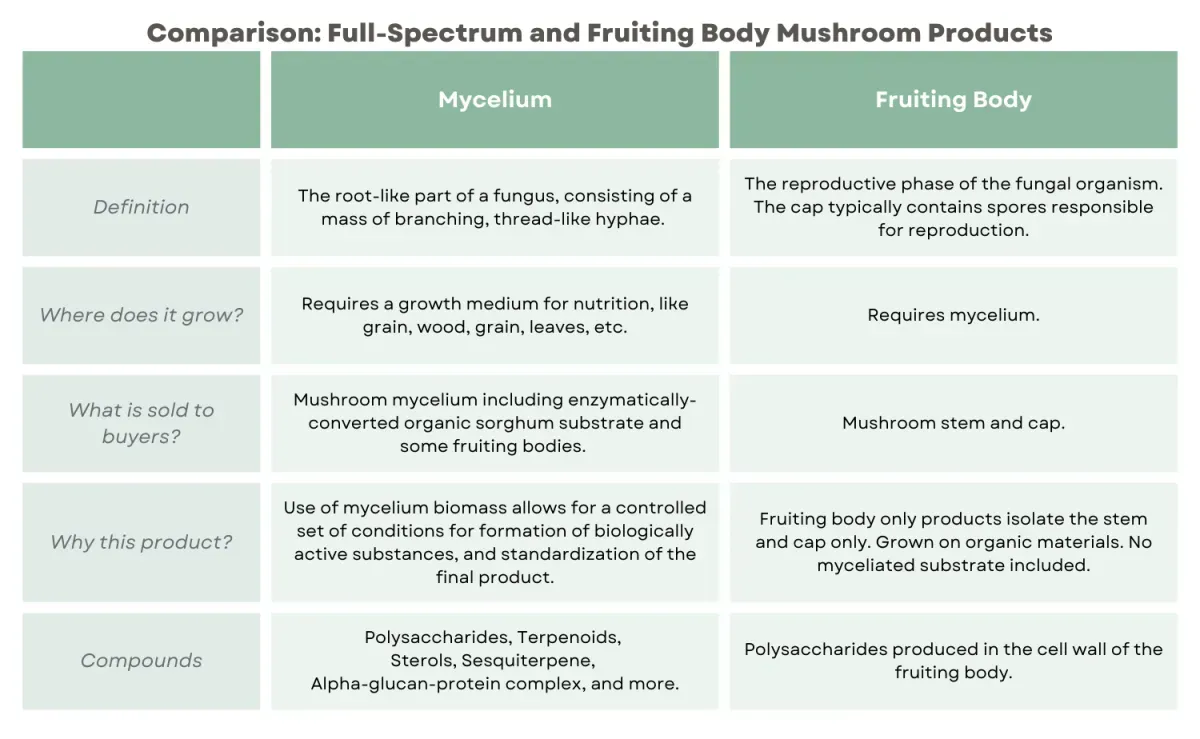
A full spectrum mushroom product contains the fruiting body, the mycelium, and the fermented substrate.
Some supplement producers only use fruiting bodies. Others use full-spectrum (mycelium + fruiting body) products. Consumers generally seem mixed up about the difference between the two products. According to Google, one of the top searches on the term “full spectrum” included “what does full spectrum mean mushrooms”.
A description of the mushroom growing cycle may help with that.
Mushroom Growing Cycle
Mushrooms consist of three parts: mycelium, fruiting bodies, and spores. Scientists estimate that mushrooms are 95% mycelium, 4.8% fruiting bodies, <0.2% spores. Each of the three parts of a mushroom have their own distinct roles in the life cycle.
1. Mycelium. Mycelium consists of millions of filament-like threads that interconnect through a substrate. This is the longest lasting phase of the mushroom life cycle; mycelium lives for years – if not decades.
2. Fruiting body. The fruiting body is the reproductive part of the mushroom, responsible for seeding future generations of mushrooms. The fruiting body is the easiest part of a mushroom to identify. Fruiting bodies are relatively short lived; they may pin and fade anywhere between a few days to a few weeks.
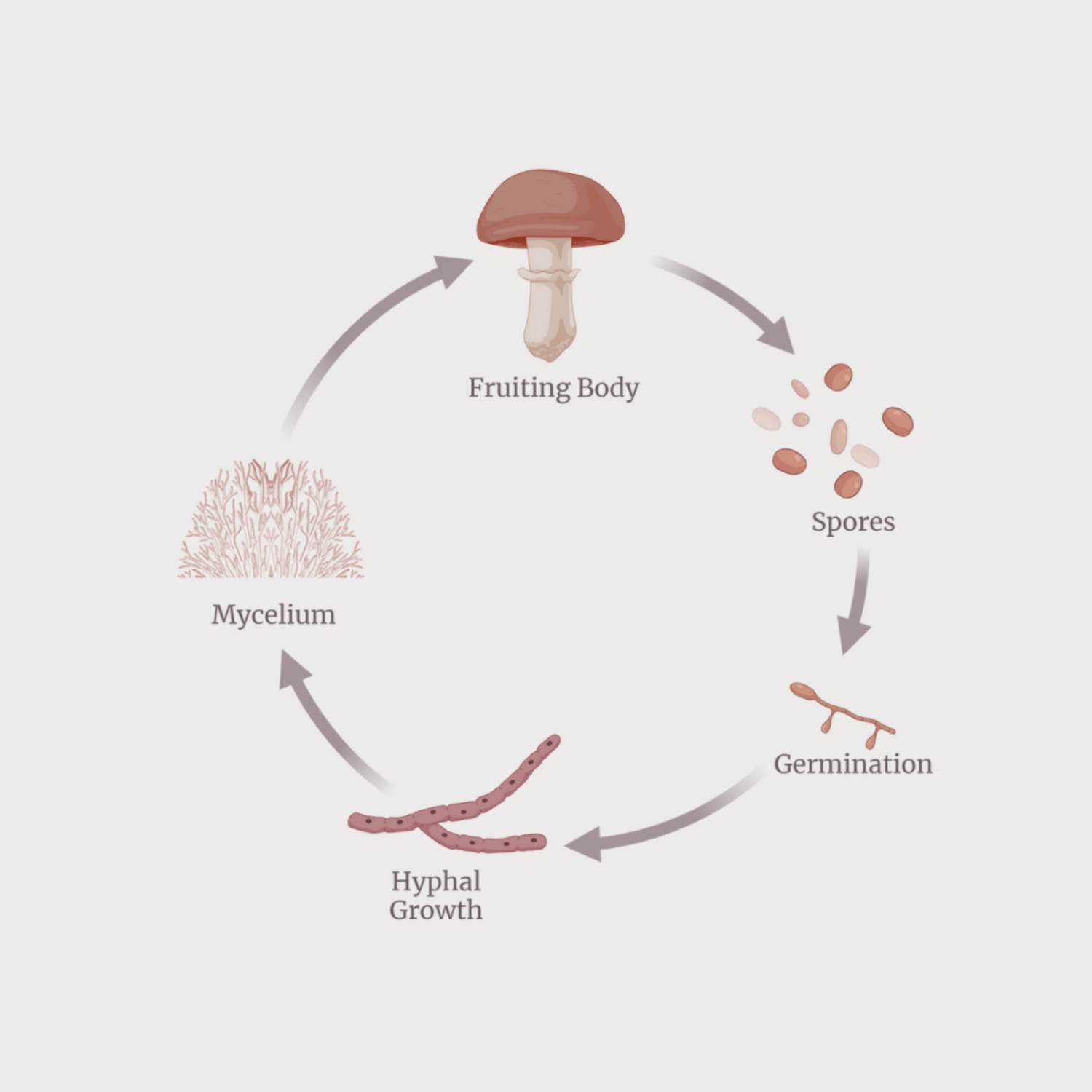
3. Spore. The reproductive cells responsible for creating new mycelial networks. The fruiting body eventually drops spores, aka the mushroom seeds. Together the mycelium, the fruiting body, and the spore create a whole mushroom life cycle.
Myzel’s Approach
Myzel Organics is dedicated to the production of full-spectrum mushroom powders. These mushroom products include novel compounds secreted by the mycelium into the substrate during the growth process. The compounds are unique to mycelium, and not available in the fruiting bodies alone.
We test each batch to understand contents, including the active compounds, allergens, heavy metals, pesticides, and pathogens. Each product is available with a Certificate of Analysis to guarantee the quality of our full-spectrum products.
Loving the Whole Lifecycle
At Myzel, we take a holistic approach to mushroom cultivation. We value each and every stage of the mushroom lifecycle. Our mushrooms are left to grow until they completely digest their growth medium. This ensures that the mushrooms have amply opportunity to secrete all their novel compounds into the substrate. We simply want the best for our mushrooms and our clients!
Connect Like Mycelium



Drop your email address below to get our newsletter.
Created with © systeme.io
Privacy policy | Terms of use | Cookies